
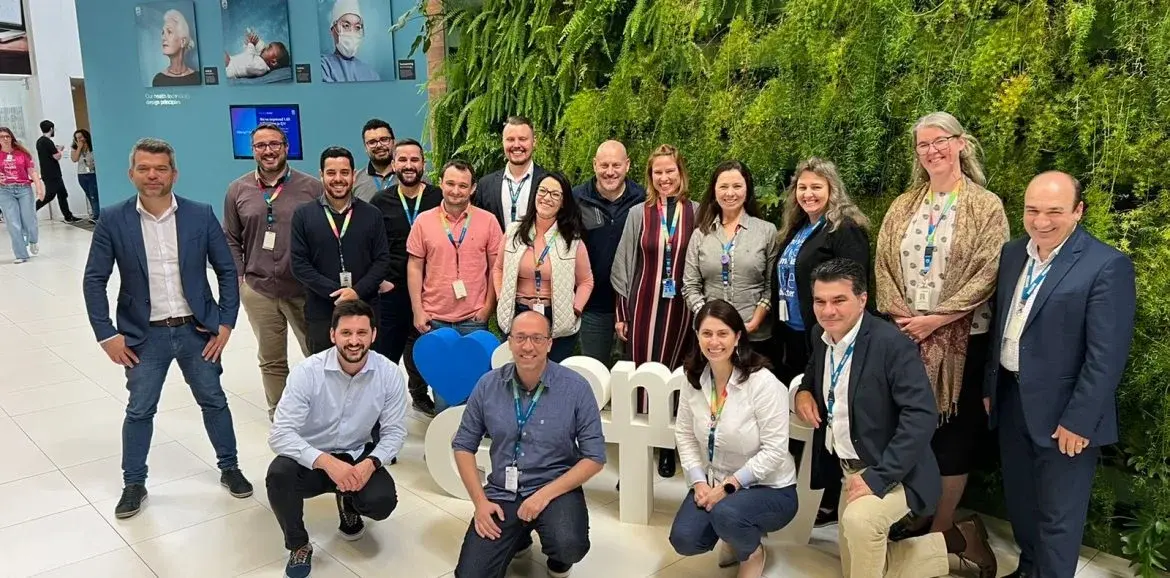
This case study reflects work led by Michael Renna, Founder of Alacient, during his tenure as Agile Transformation Business Leader at Philips EMR. The transformation was executed in partnership with Philips leadership and a team of SPCs, and illustrates the operational impact of Scaled Agile practices applied at enterprise scale.
Executive Summary
Philips EMR had reached a critical inflection point. More than fifty simultaneous initiatives — many unprofitable — were draining resources, while legacy practices and cultural inertia stifled innovation. An earlier SAFe® transformation had failed to take root.
A renewed transformation effort began in April 2022 with strong executive sponsorship and the onboarding of Michael Renna as Agile Transformation Business Leader, supported by several SPCs and a coalition of cross-functional leaders. Over approximately 18 months (April 2022 through late 2023), the organization underwent a sweeping Scaled Agile transformation: twelve Agile Release Trains reorganized around value delivery, ~1,000 employees trained, a Lean-Agile Center of Excellence established, and — critically, where the prior attempt had not — Lean Portfolio Management embedded. Active initiatives were rationalized from 50+ down to roughly 20 strategically aligned efforts.
Over the same period, the business improved materially, including a 23-point EBITDA improvement. As detailed below, that improvement reflected multiple drivers — the portfolio discipline established through this transformation among them, alongside cost actions led elsewhere in the business.
Initial Landscape
- Fragmented Initiative Landscape: 50+ active projects, many lacking ROI clarity
- Delayed & Unpredictable Releases: Delivery timelines were inconsistent and opaque
- Project List Masquerading as Strategy: No clear linkage between strategic goals and execution
- Legacy Culture: Resistance to change, anchored in a 135-year history of “this is how we’ve always done it”
- Failed SAFe® Attempt: A prior transformation that lacked traction and sustainability
Transformation Approach
Leadership and change enablement
- Committed executive sponsorship providing strategic direction and the mandates essential to organizational change.
- A compelling change narrative to align teams around a shared vision and transformation goals.
- Michael Renna (SPC) onboarded as Agile Transformation Business Leader.
- A Lean-Agile Center of Excellence (LACE) established to guide implementation and coaching.
- Cross-functional change champions trained to drive adoption across disciplines.
- Philips University support for SAFe training and certification licensing.
Structural overhaul
- Value stream identification workshops: reorganized twelve Agile Release Trains (ARTs) around value delivery.
- SAFe® training for ~1,000 employees: role-specific curricula delivered across the enterprise.
- Product management as a discrete discipline: stood up a fully formed product organization.
Practice modernization
- Measure & Grow assessments: identified competency gaps and targeted coaching needs.
- Azure DevOps customization: enhanced to support SAFe® workflows, KPIs, and visibility.
- Cadence-based ceremonies: introduced across all levels for feedback loops and transparency.
Lean Portfolio Management: The Game Changer
The most transformative element was the implementation of Lean Portfolio Management (LPM) — absent in the previous SAFe® attempt. This directly challenged Philips’ entrenched project-centric mindset and is the discipline most directly responsible for the portfolio-level results.
Key LPM actions
- Value stream funding: shifted portfolio management from project-centric budgeting to funding value streams, aligning investment with strategy.
- Simplified strategy: strategic plans expressed and executed through epics and lean-startup practices, creating clearer, more actionable goals.
- Economic sequencing: WSJF used to prioritize initiatives for greatest value, directing resources where they mattered most.
- Epic evaluation: unprofitable epics paused or terminated.
- Flow distribution and capacity allocation: balanced investment to optimize throughput and ensure only viable ideas advanced.
- Agile cost accounting: story points and total cost of ownership used to give a clearer view of investment and return.
Outcomes and impact
The transformation produced clear, directly attributable operational change, and coincided with strong business results to which it was a meaningful contributor.
Operational outcomes (directly attributable to the transformation)
- Initiative portfolio rationalized from 50+ active projects to ~20 strategically aligned efforts.
- Twelve ARTs reorganized around value streams.
- ~1,000 employees trained; Agile maturity embedded across roles and levels.
- A standing LACE and a discrete product organization established.
- Release cadence and transparency materially improved from a low, opaque baseline.
- Team engagement shifted from sporadic to broad participation and ownership.
Business results over the transformation period (multiple drivers)
These reflect the performance of the business over the period. The transformation was a significant contributor — particularly through portfolio rationalization and the reallocation of investment toward higher-value work — alongside cost-structure actions led elsewhere in the organization.
- EBITDA improved by 23 points. This improvement was driven by several levers: the portfolio rationalization and Lean Portfolio Management discipline established through the transformation, together with cost actions (including workforce reductions) managed outside the transformation’s scope. Presented as a business outcome the transformation contributed to, not one it solely produced.
- Sales and order intake grew ~25% from a 2021 baseline to 2023, supported by a sharper focus on high-value priorities.
- Portfolio health improved 5–10%, reflected in higher throughput and stronger quality behaviors.
| Metric | Before | After (~18 months) | Attribution |
|---|---|---|---|
| Active initiatives | 50+ | ~20 strategically aligned | Directly attributable |
| Release predictability | Low, opaque | High cadence and transparency | Directly attributable |
| Strategic clarity | Fragmented | Unified vision and execution | Directly attributable |
| Agile maturity | Nascent | Embedded across roles and levels | Directly attributable |
| Team engagement | Sporadic | Broad participation and ownership | Directly attributable |
| EBITDA | — | +23 points | Contributed to (multiple drivers) |
| Sales / order intake | 2021 baseline | ~+25% by 2023 | Contributed to (multiple drivers) |
Conclusion
Michael Renna’s leadership revived a previously failed SAFe® initiative and redefined how Philips EMR delivers value. By embedding Lean Portfolio Management, reorganizing around value streams, standing up a product organization, and empowering teams through training and transparency, the transformation produced durable operational change — a rationalized portfolio, a healthier operating model, and Agile maturity embedded across the enterprise.
Those operational changes were a meaningful contributor to strong business performance over the period, including a 23-point EBITDA improvement delivered alongside broader cost and commercial actions. The result is a blueprint for enterprise-scale agility grounded in real operating change rather than ceremony.