The uncomfortable test
Here’s a quick test for your Lean-Agile Center of Excellence: does it make your organization uncomfortable?
Not chaotic. Not finger-pointing. Just honest enough to name what everyone already knows — the places where the transformation story doesn’t match what’s actually happening on the ground.
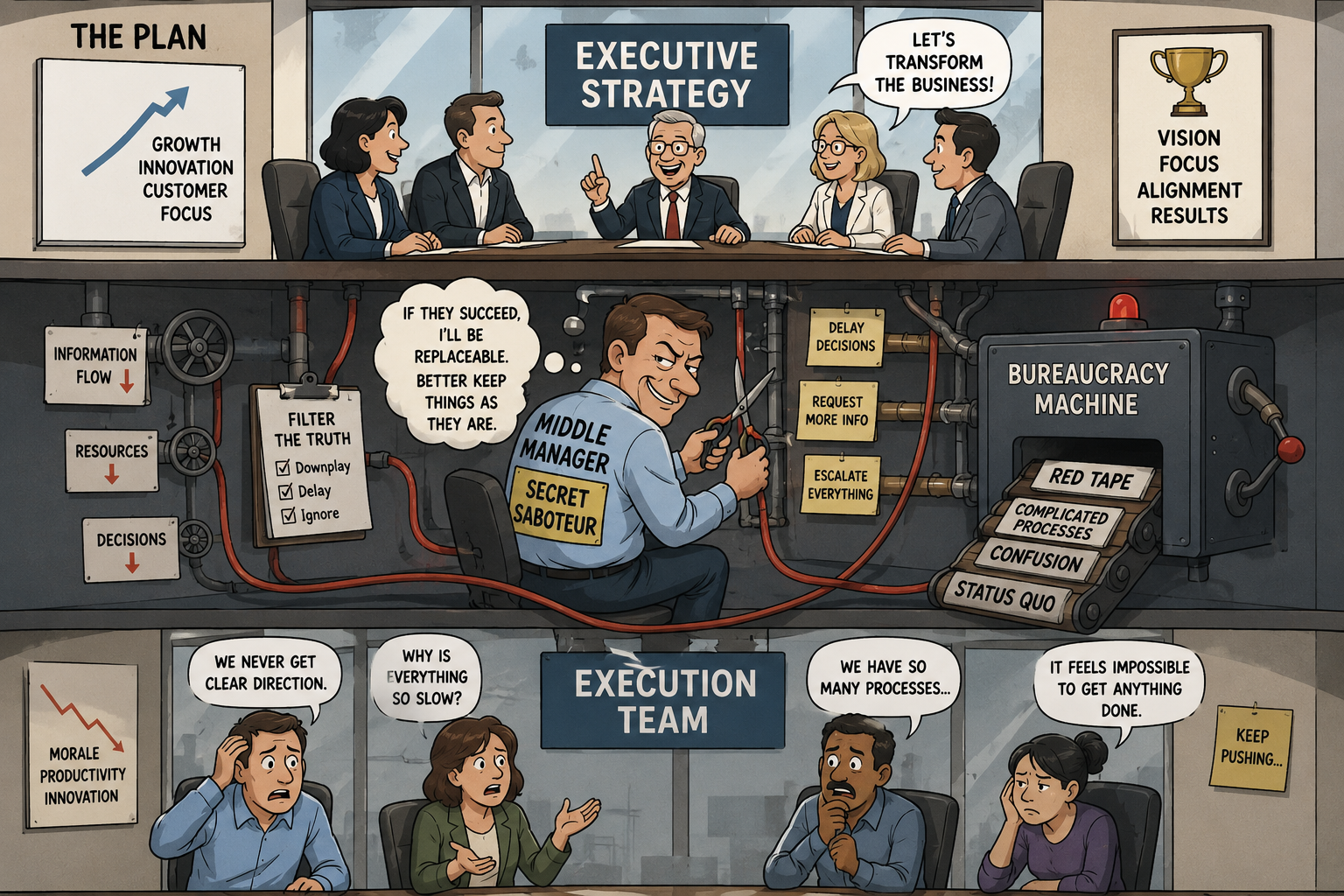
If leaders are saying teams are empowered, but every meaningful decision still requires sign-off from three governance forums, someone should say that out loud. If teams are being asked to improve flow while funding and staffing still operate on annual project cycles, that contradiction deserves attention. If people are resisting the change, the first instinct shouldn’t be to call them “anti-agile.” It should be to ask why.
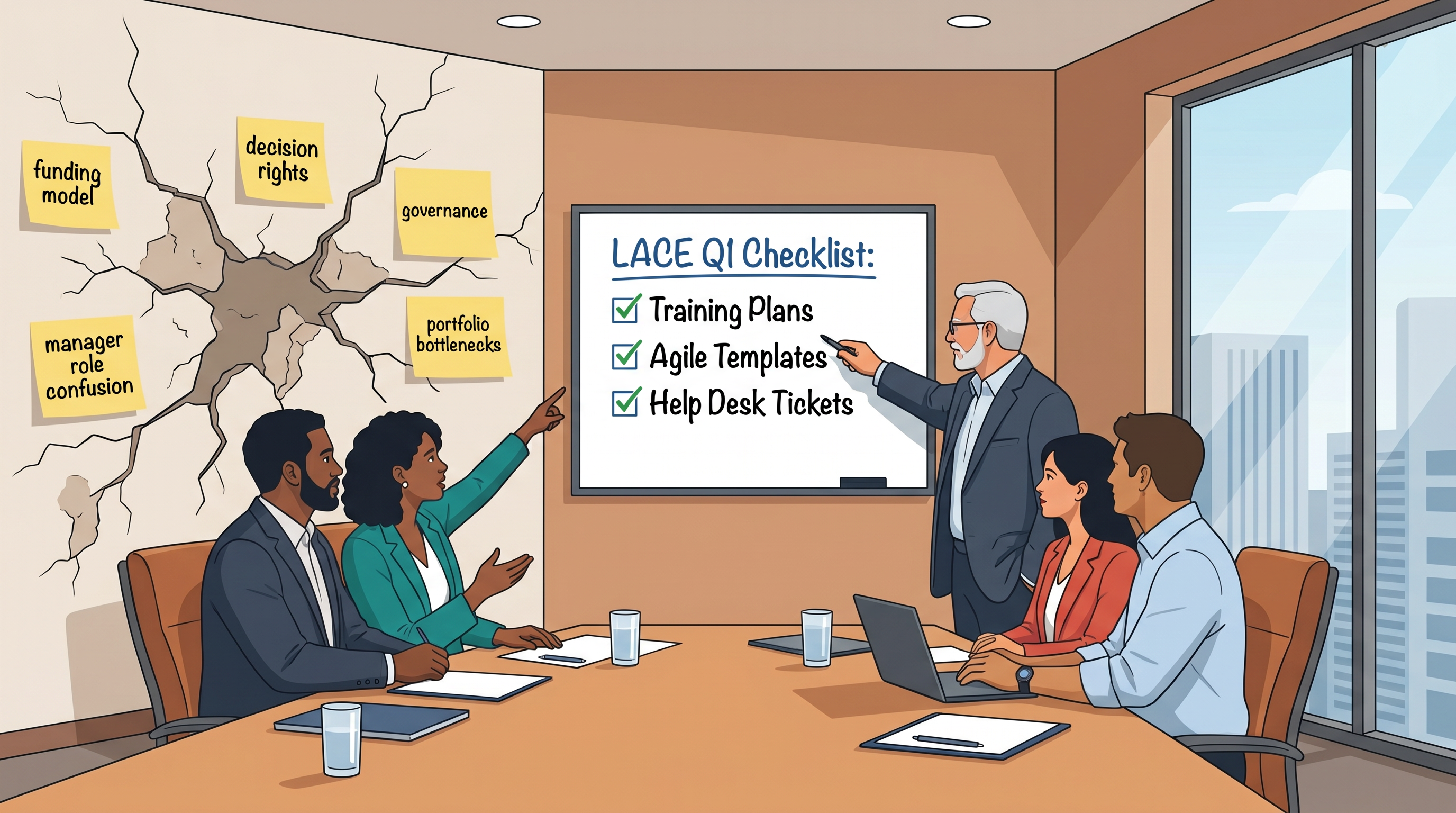
That’s the real work. Not facilitating ceremonies. Not distributing PI Planning templates. Not building a SharePoint site full of agile resources that nobody reads.
A LACE should close the gap between what leadership says it wants and what the organization actually rewards.
The agile help desk trap
Most LACEs start with the right intentions. You bring together coaches, transformation leads, a few well-placed advocates, maybe some senior leaders who genuinely care about making this work. The group starts coordinating training, helping teams, answering framework questions.
And for a while, it works fine. People are learning. Things are moving.
Then something shifts. The LACE gets busy — really busy — and stops looking up from the day-to-day work long enough to notice that the deeper organizational issues haven’t moved at all.
Funding still flows to projects instead of products. Governance still demands certainty in a quarterly planning cycle that doesn’t reflect how teams actually work. Middle managers are being told their role is changing, but nobody has helped them figure out what that means practically. Teams get told to own outcomes while key decisions still sit three levels above them.
The LACE is busy. The transformation isn’t working. And those two facts start to feel incompatible.
That’s the agile help desk trap. The organization builds a responsive, knowledgeable, well-meaning center of support — and then uses it to avoid the harder work of changing how the business actually operates.
Coalition means you move things
John Kotter’s work on organizational change — most famously in Leading Change — makes the case that meaningful change needs a guiding coalition. Not a committee. A coalition.1 People with enough credibility, reach, and shared commitment to move an organization through something genuinely difficult.
That’s a high bar. And it’s the right one.
Scaled Agile describes the LACE as part of that guiding coalition for change.2 The word “part” is worth paying attention to. A LACE doesn’t replace executive leadership. It isn’t a governance body with formal authority over everyone. But it can become the connective tissue between strategy and reality — the group that sees what’s happening across the organization and does something about it.
The difference between a coalition and a committee comes down to what the group does when things get hard. A committee receives updates, documents concerns, and escalates for a decision that may or may not come. A coalition investigates, makes tradeoffs, and keeps moving. A committee tracks that training happened. A coalition asks whether anything changed because of it.
If your LACE meetings feel like a round-robin status update, that’s a signal. The group may be functioning as a committee when the transformation needs a coalition.
Who’s in the room matters more than people admit
One of the more predictable failure modes in any transformation: the people designing the change aren’t representative of the people living through it.
The result is that change gets perceived as something being done to the organization rather than with it. Business partners sense that “agile” is really an IT initiative and keep their distance. Teams learn to comply just enough to get through the next assessment. Managers who haven’t been given real clarity on their role quietly wait for the whole thing to pass.
A well-designed LACE prevents this by including people who represent the actual breadth of the organization — business, technology, product, portfolio, finance, operations, delivery, and credible practitioner voices close to the real work. Not everyone. Not every department with a ceremonial seat. But enough cross-functional representation that the coalition can see the organization’s real constraints and carry the change message into territory that a coaching team alone can’t reach.
Kotter’s current guidance pushes on this too — the guiding coalition needs diversity across levels, functions, and tenure, not just titles and positional authority.3 If your LACE is mostly agile coaches and transformation office staff talking to each other, it’s probably operating in an echo chamber.
What makes a good LACE member
Not enthusiasm. Enthusiasm is fine, but it’s easy to find and it doesn’t move organizations.
The people who make a real difference on a LACE tend to have credibility with leaders and teams — which is rarer than it sounds. They can influence direction without needing a reporting line to do it. They know the business well enough to connect a Lean-Agile practice to an actual operational outcome, rather than arguing for the practice on principle. And when they hit a systemic impediment that nobody wants to touch, they don’t just log it. They stay with it.
That last part gets underestimated. Transformation work is full of issues that are known, documented, acknowledged, and then… not resolved. The funding model doesn’t align. The governance process creates the wrong incentives. A key leader is sending mixed messages. These things can live on a LACE backlog for months with no real movement.
The organizations that make progress tend to have people on their LACE who treat those items as personal accountability — not just the organization’s problem, but theirs to push on until something shifts.
The LACE needs its own backlog
If the LACE is doing real work, it should have a backlog that reflects the most important constraints to change. Not a list of agile activities or upcoming training events. A genuine prioritized list of the things most likely to determine whether the transformation succeeds.
That might mean clarifying decision rights that have been ambiguous for two years. It might mean working with finance to revisit how initiatives are funded. It might mean helping a group of managers navigate the change in their own role rather than assuming they’ll figure it out. It might mean building a communication rhythm that actually reaches the people who are confused rather than the people who are already bought in.
The LACE meeting should be a working session around the highest-priority constraints, with owners and some expectation that things will move between meetings. Not a briefing. Not a status check. A working session.
The questions worth spending time on: Where is the friction right now? Where is the organization saying one thing and rewarding another? What are teams telling us that leaders haven’t heard yet?
Communication is not an announcement problem
Most transformations send too many announcements and not enough real communication.
The announcements are usually positive. They talk about the vision, the empowerment, the customer focus. They’re not wrong. They’re just not specific enough to change behavior, and after a while, people stop reading them.
What people actually need to know is more practical. Why are we doing this? What’s expected to change, specifically, in how we work? What’s already decided versus what’s still open? What has leadership changed about its own behavior? Where are we making real progress and where are we stuck?
LACE members can carry that kind of communication because they’re already embedded in different parts of the organization. They’re not announcing; they’re translating. They’re taking the transformation message and making it relevant to a portfolio team, or a group of delivery managers, or a set of product owners who have real concerns that the standard FAQ doesn’t answer.
That two-way communication — where feedback flows back into the coalition and actually changes how the transformation adapts — is worth more than any amount of broadcast messaging.
Show the work
A LACE should be able to demonstrate that the system is changing.
Not training counts or ceremony adoption rates. Those tell you whether activities happened. They don’t tell you whether the organization is actually working better.
The more honest measures look at flow — how work moves from idea to delivery. Decision speed. Whether dependencies are getting resolved faster or slower. Quality trends. Whether teams have more or less clarity on priorities than they did six months ago. Whether leadership conversations are different.
The specific measures depend on what the transformation is trying to fix. But the discipline of connecting LACE work to traceable outcomes is what separates a credible transformation function from a well-funded support service.
If the LACE is working on leadership alignment, what behavior is supposed to change, and how will you know it has? If it’s working on portfolio flow, what delay should go down? If communication is improving, what confusion should be decreasing?
A LACE that can answer those questions — and show real movement over time — builds the kind of credibility that lets it keep doing hard work. One that can’t will eventually be seen as overhead.
The actual test
The test for a LACE isn’t whether it exists, or has a charter, or runs a community of practice.
It’s whether the LACE helps the organization be honest with itself about why change is hard — and then does something about it.
That means surfacing friction, not smoothing it over. Including voices that don’t usually sit at the transformation table. Treating resistance as information rather than opposition. Helping leadership make real tradeoffs rather than aspirational commitments.
A LACE that does those things becomes something the organization actually relies on. Not because it’s a requirement of whatever framework you’re running, but because it’s the group that closes the gap between intent and reality.
That’s a harder job than running training. It’s also the one that matters.
Sources
-
Kotter International, “The 8 Steps for Leading Change”: https://www.kotterinc.com/methodology/8-steps/
-
Scaled Agile Framework, “Create a Lean-Agile Center of Excellence”: https://framework.scaledagile.com/lace/
-
Kotter International, “8 Steps to Accelerate Change in Your Organization”: https://www.kotterinc.com/wp-content/uploads/2024/06/8-Steps-eBook_2024-Update2.pdf
← All insights